


When to Repair vs Replace Your Industrial Air Compressor in Malaysia
Industrial air compressors are critical assets in Malaysian factories, workshops, and production facilities. They power pneumatic tools, production lines, and process systems, making their reliability vital. But like any mechanical system, compressors face wear, efficiency loss, and unexpected breakdowns over time.
For facility managers, operations engineers, or business owners, the key question is: “Should I repair my air compressor, or is it time to replace it?”
Seeking professional Air Compressor Repair & Service Malaysia can help extend the life of your equipment and ensure reliable operation.
Making the wrong decision can lead to increased downtime, higher operational costs, and reduced productivity. This guide dives deep into technical considerations, cost analysis, and practical steps to help you make a data-driven choice.

Understanding Compressor Lifespan and Common Failures
Industrial air compressors can last anywhere from 10–20 years depending on type, usage, and maintenance. But several factors can accelerate failure:
1. Mechanical Wear
- Bearings, pistons, and rotors are subject to mechanical stress.
- Reciprocating compressors often fail due to worn piston rings or valves, while rotary screw compressors may experience air-end wear.
- Excessive wear leads to reduced efficiency, vibration, and noise.
2. Contamination and Oil Problems
- Oil-lubricated compressors can suffer from oil degradation, sludge buildup, or oil carryover.
- Oil-free compressors may face premature failure if intake air is not filtered properly, leading to corrosion or overheating.
3. Electrical and Control System Issues
- Motor failures, worn belts, or faulty starter circuits are common in older systems.
- Advanced compressors often have electronic monitoring; older units rely on manual monitoring, making early detection of faults harder.
4. Air Leakage and Pressure Loss
- Even small leaks in hoses, fittings, or tanks can reduce output efficiency by 10–20%, wasting energy and increasing wear.
Key Indicators: Repair or Replace?
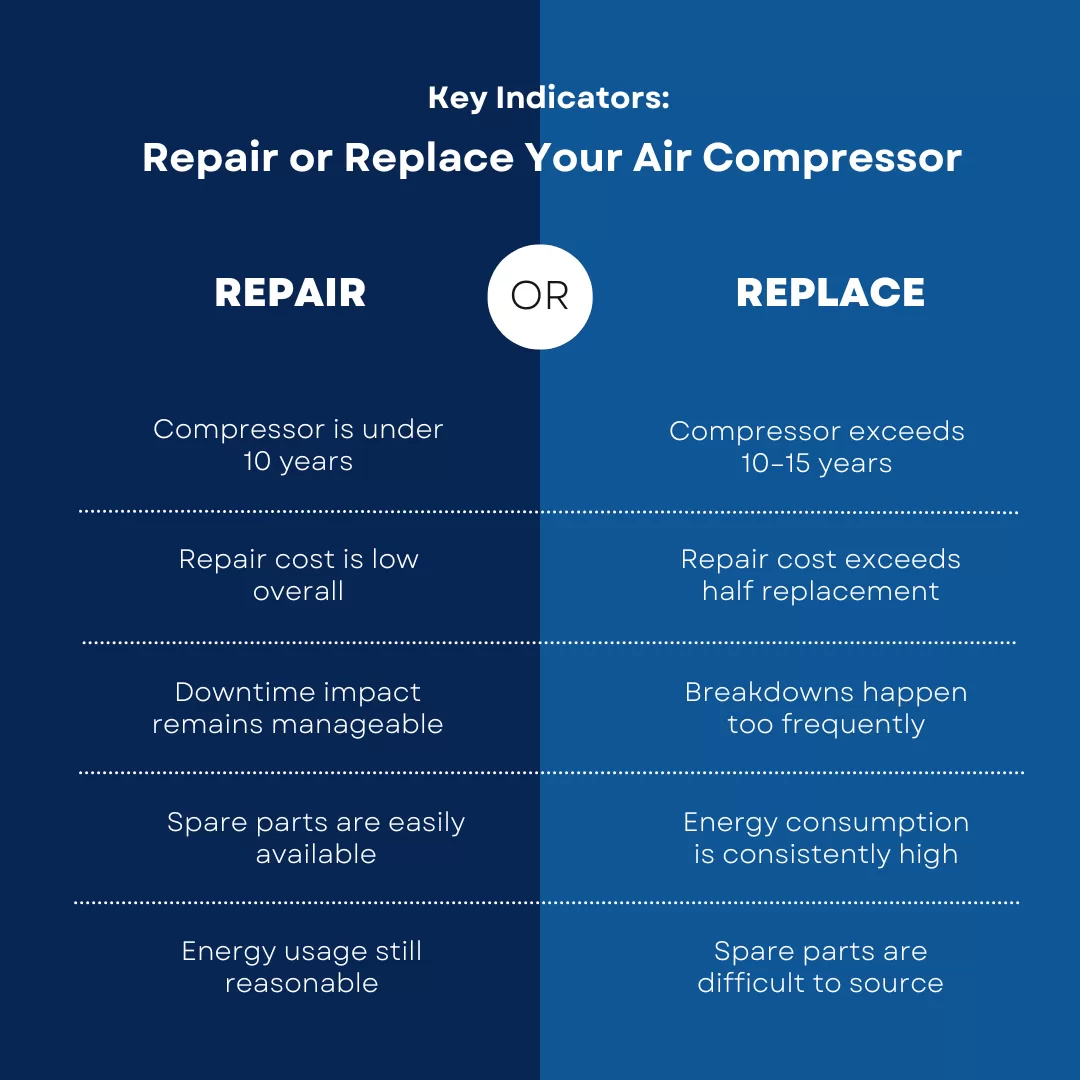
When evaluating whether to repair or replace, Malaysian facilities must consider several technical and operational factors:
A. Age and Remaining Lifespan
- Compressors over 10–15 years old may cost more in repairs than their value.
- Units under 5–10 years old with proper maintenance are usually worth repairing.
B. Total Cost of Ownership (TCO)
- Calculate repair costs, downtime costs, and energy consumption.
- Compare this with the cost of a new, more energy-efficient unit.
- Example: A 15-year-old compressor requiring $5,000 in major repairs may be less cost-effective than a new Xinlei rotary screw compressor, which offers lower energy consumption and higher reliability.
C. Reliability Needs
- For continuous production operations, even a single breakdown can halt production.
- If reliability is critical, replacement is often safer than repeated repairs.
D. Energy Efficiency
- Modern compressors with Variable Speed Drive (VSD) technology adjust output to demand, reducing electricity bills by up to 30%.
- Older compressors often operate at constant speed, consuming unnecessary power even at low load.
E. Spare Parts Availability
- Older models may require hard-to-source components, increasing lead times and repair costs.
- New compressors come with warranty-backed parts, and local suppliers in Malaysia often provide ongoing support.
Technical Steps for Decision-Making
1. Conduct a Full System Audit
- Use ultrasonic detectors to check for leaks.
- Inspect air-end, pistons, and rotors for wear.
- Measure energy consumption and efficiency against manufacturer specs.
- Monitor operational hours, vibration levels, and oil condition.
2. Repair Cost Analysis
- Include parts, labor, and downtime.
- Factor in potential hidden costs like reduced efficiency or recurring issues.
3. Replacement Cost Analysis
- Include purchase, installation, commissioning, and training.
- Account for potential energy savings, improved reliability, and compliance with Malaysian safety standards.
4. Risk Assessment
- Consider the cost of unscheduled downtime.
- Evaluate the risk of catastrophic failures in older compressors.
- Assess potential safety hazards due to aging equipment.
When Repair Makes Sense
- Compressor is relatively new (<10 years) and well-maintained
- Major components are still in good condition
- Replacement cost is high relative to repair
- Downtime is acceptable for planned repairs
- Parts are readily available from suppliers in Malaysia
When Replacement is Recommended
- Compressor is over 10–15 years old
- Repair costs exceed 50–60% of a new unit
- Frequent breakdowns are disrupting operations
- Energy inefficiency is increasing operating costs
- Safety compliance cannot be guaranteed with the old unit
- Spare parts are scarce or obsolete
Conclusion
For Malaysian industries, the decision to repair or replace an industrial air compressor should never be made lightly. It requires a careful assessment of mechanical condition, operational reliability, energy efficiency, TCO, and safety compliance.
Repairing may be cost-effective for newer units with minor issues, while replacement is often the smarter choice for older, inefficient, or frequently failing compressors.
Consulting with a certified air compressor repair and service provider in Malaysia helps ensure that your decision aligns with operational goals, safety standards, and budget requirements.
Explore ISM Malaysia’s full range of Xinlei air compressors and service solutions to keep your production line running efficiently, safely, and reliably.
Strategic Advantage: Partnering with a Local Supplier
Partnering with a trusted air compressor supplier and repair service in Malaysia ensures informed decision-making. Providers like ISM Malaysia offer:
- Expert evaluation and diagnostics
- Access to genuine Xinlei air compressors and parts
- Preventive maintenance programs
- Technical support and training for operators
By leveraging local expertise, you can reduce downtime, optimize energy efficiency, and extend equipment lifespan.
Get Expert Advice Today!
Make the best decision for your air compressor. Contact ISM Malaysia now for a full evaluation and discover our range of Xinlei air compressors. Ensure your production lines run efficiently and safely.
Top Questions About Air Compressor Repair & Service in Malaysia
When should I repair my air compressor instead of replacing it?
Repair usually makes sense if the compressor is less than 10 years old, well-maintained, and the repair cost is small compared to buying a new unit.
How do I know it’s time to replace my air compressor?
You should consider replacement if your compressor is over 10–15 years old, breaks down often, uses too much electricity, or if spare parts are hard to find.
Can repairing an old compressor save money?
Sometimes—but not always. If repair costs exceed 50–60% of the price of a new compressor, replacing it is usually more cost-effective in the long run.
How long does an industrial air compressor normally last?
Most compressors last 10–20 years depending on type, usage hours, and maintenance quality.
What services does ISM Malaysia provide?
We provides air compressor repair & service, preventive maintenance, system installation, diagnostics, and supply of Xinlei air compressors, helping businesses keep their compressed air systems efficient and reliable.
Disclaimer
We hope you found this article informative. The content provided is for general informational purposes only and does not constitute advice or necessarily reflect the full scope of services offered by Instant Scaffolds & Machinery Sdn. Bhd. (ISM). Readers are encouraged to consult with a qualified industry professional or contact our team for solutions tailored to their specific project needs. While we strive to ensure accuracy and completeness in our blog posts, we cannot guarantee they are entirely error-free. Instant Scaffolds & Machinery Sdn. Bhd. (ISM) assumes no responsibility for any errors or omissions.